
Short answer
For most shade trees in Smithfield, NC, the best time for trimming is late winter or early spring, while dead, broken and rubbing limbs can come out any time of year. The cuts should be made just outside the branch collar, no more than a third of the crown should come off in a year, and a tree should never be topped. Those are NC State Extension's rules, and they hold for the oaks and pines over Johnston County houses.
To have a tree looked at, call (984) 230-9281. One independent contractor working in Smithfield and nearby towns comes out and prices the job.
When is the best time to trim trees in Smithfield?
NC State Extension's pruning guide, written by horticulture specialist Barbara Fair, suggests waiting for late winter or early spring and points out that autumn is when decay fungi are releasing spores. It also warns against heavy pruning during the dormant season on large, mature trees. Broken, dead, weak or heavily shaded branches can be removed "anytime" (NC State Extension, General Pruning Techniques, AG-780-03, revised Mar 5, 2025, checked Nov 21, 2026).
In practice, that gives Smithfield owners two kinds of trimming:
- Planned pruning to shape a tree, lift low limbs or thin it, booked for the late-winter window.
- Safety work on dead limbs, hangers left by a storm, or a branch scraping the roof, done whenever it's found.
What does a good pruning cut look like?
Where a branch meets the trunk there's a slightly swollen ring of bark called the branch collar. Extension's guide explains that the collar holds the tree's protective tissue, and that a flush cut against the trunk removes that zone and "increase[s] the chance of fungal organisms infecting the plant." For limbs over 2 inches thick it calls for the three-cut method: an undercut, a cut farther out that drops the weight, then the final cut at the collar, so the bark doesn't tear down the trunk.
The same guide says: "Never apply wound paint or tar." A clean cut just outside the collar leaves the protective tissue there to do its work.
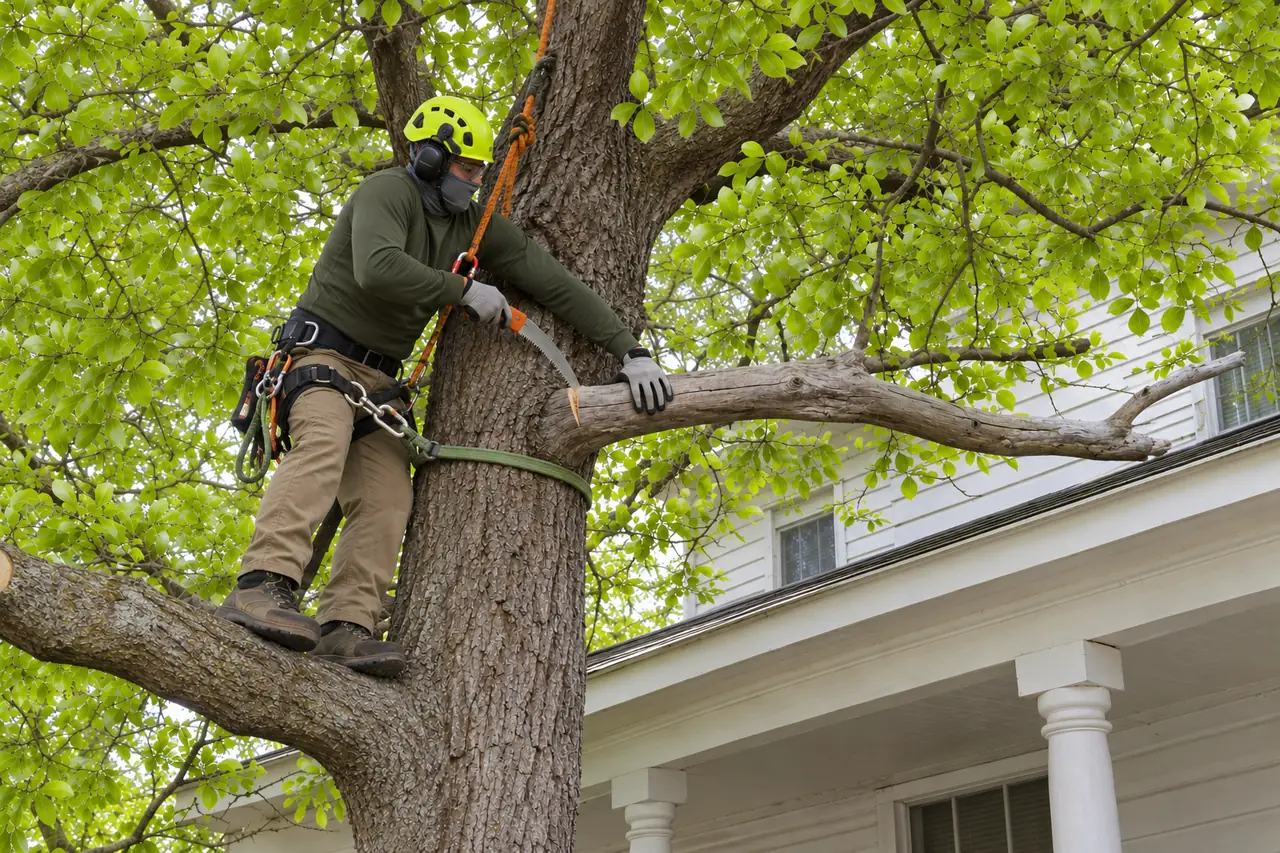
How much can come off at once?
Extension uses a one-third rule: no more than a third of a plant's total crown in any one year. For older trees in good health, the guide suggests no more than about 10 percent. That's a much smaller number than many owners expect. A big water oak that has been neglected for years usually needs its trimming spread over more than one visit, or a frank talk about whether it should stay.
Why is topping a bad idea?
Topping means cutting the top of a tree back to stubs to make it shorter. Extension's guide calls it "an inappropriate pruning practice" and says the cuts destroy the tree's architecture and will likely let decay organisms in.
Smithfield's own ordinance agrees. On property the town's tree section covers, Section 10.9.4 prohibits purposeful damage to trees and names topping as one example (Town of Smithfield UDO, checked Nov 21, 2026). Single-family homes are exempt from that section, but the advice behind it applies to every yard.
Which limbs matter most over a Smithfield roof?
- Water oak limbs. NC State Extension describes water oak as weaker wooded than most oaks (plant toolbox, checked Nov 21, 2026). Long limbs reaching over a roof are the first candidates for reduction cuts.
- Dead wood. Bare, barkless limbs in any species. They fall in ordinary wind.
- Branches on the shingles. Limbs that rub wear through roofing and give squirrels a ramp. Cutting them back to a side branch or the collar fixes it.
- Low limbs over the driveway and street. Raising the crown so a truck or a delivery van clears it.
- Pine limbs. Dead limbs high in a pine over the roof can be taken out on their own. A pine with a dying top is a removal question, not a trimming one.
What about limbs near the wire to the house?
The wire from the pole to your house is the service line. Duke Energy says the property owner "has primary responsibility to keep these lines clear of trees and vegetation," asks owners to contact the company to have the line de-energized before tree work near it, and cites OSHA and ANSI Z133 standards that an unqualified person should not work within 10 feet of overhead lines under 50,000 volts (Duke Energy trees FAQ, checked Nov 21, 2026).
Much of Smithfield gets its power from the town's own electric department rather than Duke. Town customers call the Operations Center at 919-934-2798 (Town of Smithfield utilities, checked Nov 21, 2026). The power line page sorts out who owns which wire around Johnston County.
Does trimming help before hurricane season?
It helps with limbs, not with roots. In the NWS Raleigh office's summary of Hurricane Matthew, most of the more than 1.6 million North Carolina power outages were associated with uprooted hardwood trees (NWS Raleigh, checked Nov 21, 2026). Pruning takes off dead and overextended limbs that would otherwise come down on the roof. A tree with rot at the base, heaved soil or a fresh lean is a different problem, and the honest answer may be removal.
Price ranges for trimming by tree height are on the cost page.