
Short answer
For a tree near a power line in Smithfield, NC, the first question is whose line it is, because nine different electric utilities serve parts of Johnston County. The line's owner deals with its own wires; the short wire from the pole to your house is, at least on Duke Energy's lines, mostly the property owner's job to keep clear, and it should be shut off by the utility before anyone cuts near it.
For a tree that needs work near a line, call (984) 230-9281. One independent contractor who works in Smithfield and Johnston County looks at it and works out with you what the utility has to do first.
Whose line runs through your yard?
Your electric bill answers it. PowerOutage.us, which follows outages utility by utility, lists these nine in Johnston County, with the number of customers it tracks for each (checked Nov 21, 2026):
| Utility | Johnston County customers tracked |
|---|---|
| Duke Energy | 91,819 |
| Town of Clayton (Clayton Public Power) | 8,704 |
| South River EMC | 5,041 |
| Town of Smithfield | 4,843 |
| Wake Electric | 3,564 |
| Town of Selma | 3,013 |
| Town of Benson | 2,066 |
| Tri-County EMC | 447 |
| Wilson Energy | 58 |
Source: PowerOutage.us, Johnston County, checked Nov 21, 2026. Counts change as customers are added.
Four of those are Johnston County town systems (Wilson Energy is the City of Wilson's). ElectriCities lists Benson, Clayton, Selma and Smithfield among the 32 members of the North Carolina Eastern Municipal Power Agency (ElectriCities, Understanding ElectriCities, rev. July 2026, checked Nov 21, 2026). So a house a mile outside Smithfield's electric area can be on Duke or a cooperative, even with the same mailing address.
The Town of Smithfield's own electric system
Smithfield calls itself a public power community: its Public Utilities Department operates and maintains the electric distribution system. To report a problem on the town's system, the town lists its Operations Center at 919-934-2798; the department's office is at 230 Hospital Road, open 8:00 to 5:00 on weekdays, and the main town number is 919-934-2116 (Town of Smithfield, Public Utilities, checked Nov 21, 2026).
When a private tree job needs the town's power off, the town does it. In August 2017, ABC11 reported that the town's electric department would cut power to some homes near South Fourth Street and Holt Street for most of a day so a tree could be removed safely (ABC11, Aug 8, 2017, checked Nov 21, 2026). Expect a removal over a town line to be scheduled around that kind of shutoff.
In Clayton, most homes inside town limits are on Clayton Public Power, which takes electric service calls at 919-553-1530. Its trimming program and the Duke exceptions are on the Clayton page.
Who keeps the wire to your house clear?
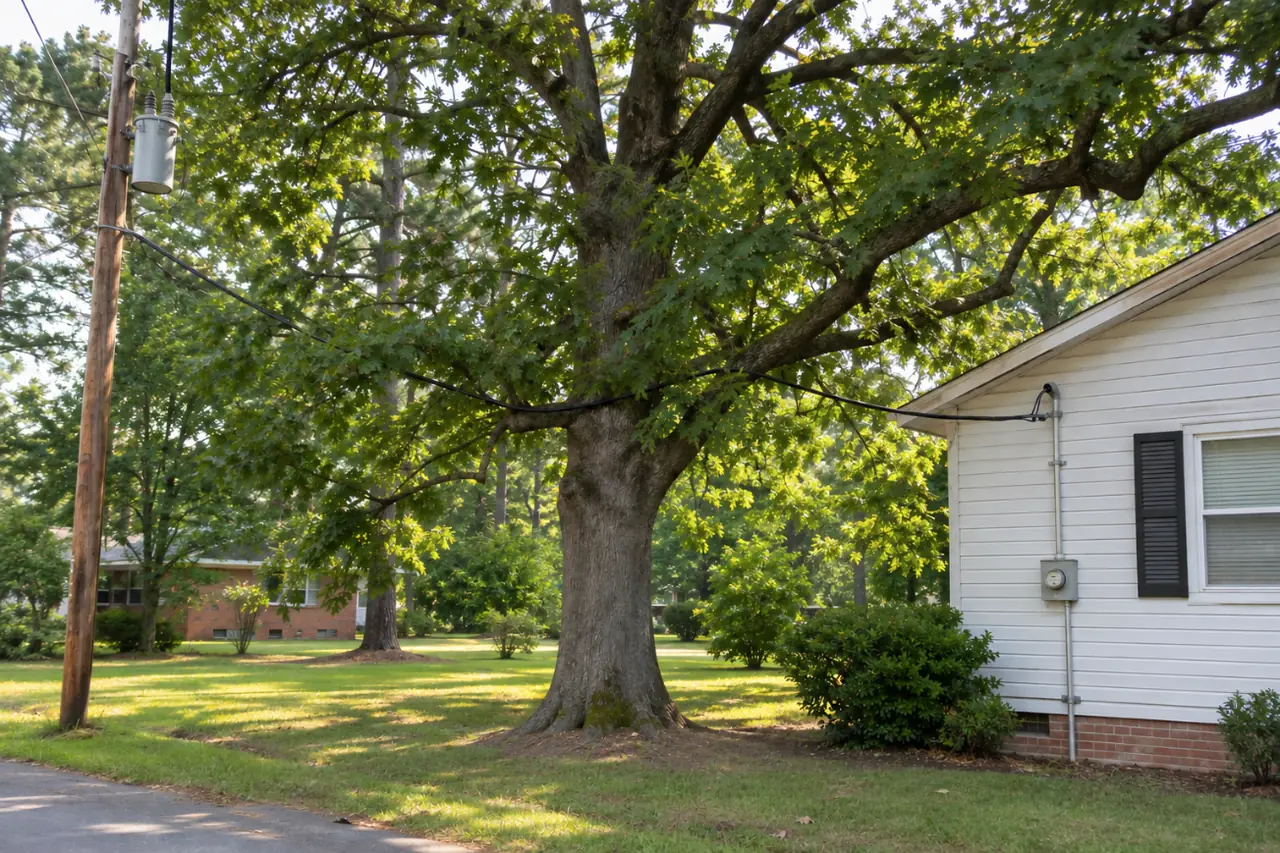
The wire from the pole to the meter is called the service line, and on Duke Energy's system the owner looks after the trees around it. Duke's tree FAQ says "the property owner has primary responsibility to keep these lines clear of trees and vegetation," and asks owners to contact the company to have the line de-energized before any tree work near it; Duke says it doesn't charge for that (Duke Energy trees and rights-of-way FAQ, checked Nov 21, 2026).
The same FAQ cites OSHA standards and ANSI Z133, the tree care safety standard, for the rule that an unqualified person should not work within 10 feet of overhead lines below 50,000 volts, with more distance for higher voltages. It also says Duke judges requests to remove a tree near its lines case by case, and doesn't clean up tree debris left after severe weather.
Town and cooperative customers should ask their own utility how it handles the service line; the procedure isn't the same everywhere.
What does North Carolina law say about working near lines?
North Carolina has its own clearance law for lines over 600 volts, the Overhead High-Voltage Line Safety Act in Article 19A of Chapter 95 of the General Statutes (G.S. 95-229.5 and following, checked Nov 21, 2026). Unless the danger has been guarded against with the line's owner:
- No person, and no tool or material they're using, may be brought within six feet of the line.
- Covered equipment, which the law defines to include things like cranes, ladders and rigging, may not come within 10 feet.
- The person responsible for the work notifies the line's owner at least 48 hours ahead, not counting weekends and legal holidays, or as soon as possible in an emergency.
The law covers "any person," and a definition in the article includes individuals. A crane lifting oak sections near the overhead lines along the street, or a ladder or pole saw near them, is exactly what it's written for. The act covers only lines over 600 volts, so ask the utility which of the wires near your tree that includes. For the wire to your house, follow the utility's own procedure above.
Rural lines and the cooperatives
Out in the county, many homes are on a cooperative. South River EMC, headquartered in Dunn, lists Bladen, Cumberland, Harnett, Johnston and Sampson as the counties it serves, with about 48,358 consumers on 4,830 miles of line; Wake Electric and Tri-County EMC also list Johnston County (North Carolina's Electric Cooperatives, checked Nov 21, 2026).
In its July 2026 member pages, South River EMC says "nearly half of all power outages can be traced back to trees and vegetation," and that wind and ice bring branches down onto lines and poles (Carolina Country, South River EMC edition, July 2026, checked Nov 21, 2026).
Where should a new tree go?
The same South River EMC article gives the spacing: trees that grow up to 40 feet tall should be planted at least 25 feet from overhead lines, and taller trees at least 50 feet away. Keep shrubs 10 feet from the front of a pad-mounted transformer and 4 feet from its sides, and call 811 before digging. A water oak or loblolly pine, both of which NC State Extension lists at 50 feet or more at maturity, belongs well back from the street line.
What to do about a tree near a line
- If it's touching or lying on a wire, stay away and call the utility, or 911 if there's fire or anyone is hurt.
- If limbs are growing into the street lines, call the utility that owns them and ask about its trimming schedule. Clayton and South River EMC both describe regular trimming along their lines.
- If limbs are around the service wire or the tree has to come down near any line, book the tree work and have the utility de-energize or cover the line first. Tell the contractor whose line it is when you call.
- Don't climb or prune near a line yourself. Near a line over 600 volts, pole saws and ladders count as tools and equipment under the state law above, and the Duke FAQ above cites a 10-foot limit for unqualified people near overhead lines.
For how removals and trimming are done, see tree removal and tree trimming. After a storm, start with the storm page.