
Short answer
Tree removal in Smithfield, NC comes down one of two ways: the tree is felled in one piece where there's open ground to drop it, or it's taken apart from the top down with ropes, a lift or a crane where it stands over a roof, a shed or a fence. At a single-family house the town's tree section doesn't apply, so most removals turn on the tree itself, the ground under it and what happens to the wood.
Call (984) 230-9281 and one independent contractor who works in Smithfield and Johnston County will come look at the tree and price the job.
Which trees come down most around Smithfield?
Two kinds account for a lot of the big trees over Johnston County houses.
Loblolly pine. NC State Extension lists it as native across the state and says it may grow 60 to 90 feet tall. Its notes on the tree name southern pine beetle and the pine engraver as insect problems and say the tree "is susceptible to wind damage" (NC State Extension plant toolbox, loblolly pine, checked Nov 21, 2026). A tall pine near a house is the classic removal call after a dry summer or a hurricane season. If one has turned rusty red at the top, read dying pines and bark beetles before deciding anything else.
Water oak. The same toolbox says water oak is commonly found in the Coastal Plain and Piedmont of North Carolina in bottomland forests, usually grows 50 to 80 feet tall, and is short-lived for an oak, with a life span of roughly 30 to 50 years. It calls the tree weaker wooded than most oaks and notes it is susceptible to oak wilt, "often with fatal consequences" (NC State Extension plant toolbox, water oak, checked Nov 21, 2026). By that measure, a water oak that has shaded a house for 40 or 50 years is already at the far end of the life span the toolbox gives.
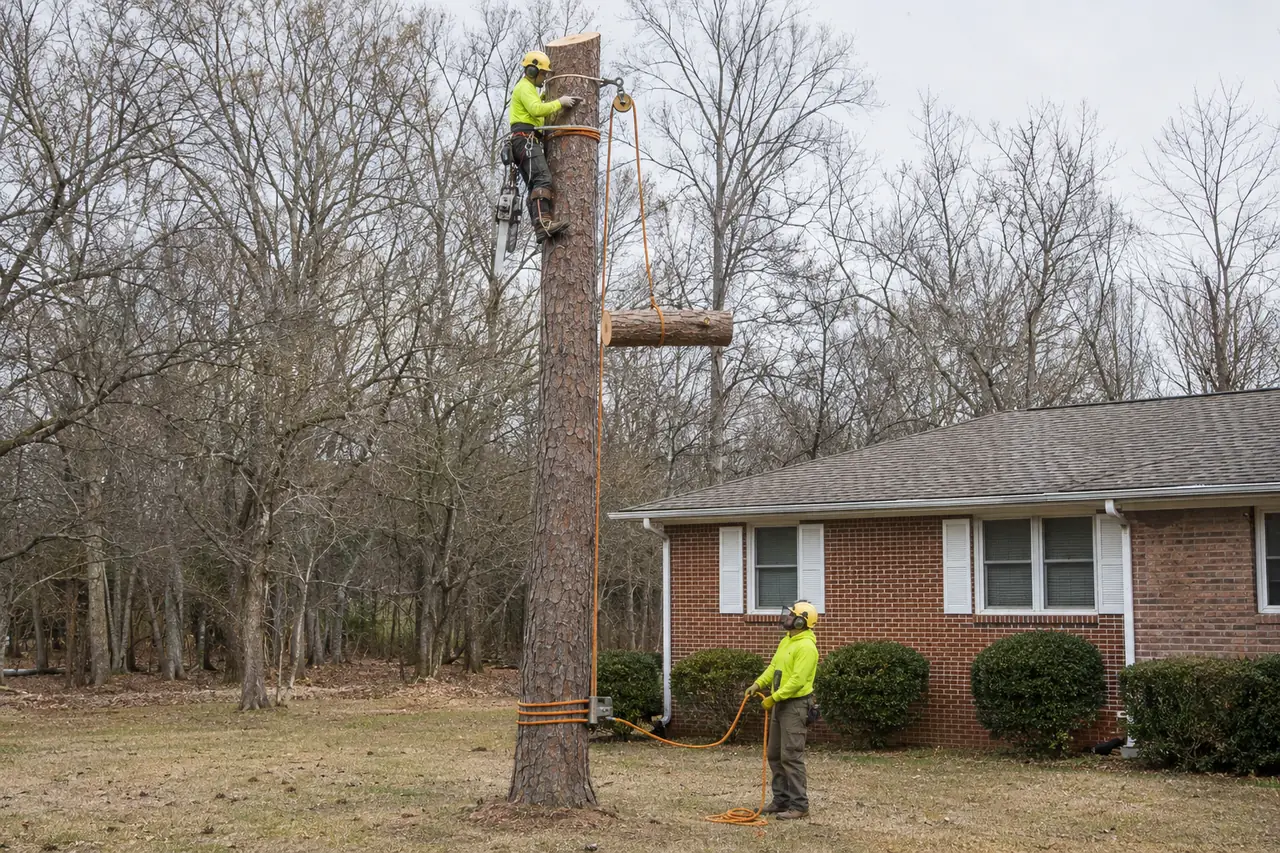
Felled whole or taken down in pieces?
The yard decides this more than the tree does.
- Felled in one piece. When there's a clear lane longer than the tree is tall, with no house, fence, car or wire in it, the crew notches the trunk and drops the tree where they aimed it. It's the quickest method and usually the cheapest.
- Climbed and lowered. A climber works up the trunk, cuts limbs and then sections of trunk, and lowers each piece on a rope so nothing drops loose onto the roof. This is the common method for a pine growing a few feet from a brick ranch.
- From a bucket truck or lift. Where a truck or a tracked lift can reach the tree, the cutter works from the bucket instead of climbing. Gates, septic areas and soft lawns limit where a truck can go.
- With a crane. For a large tree behind a house, with no room to drop pieces, a crane lifts sections over the roof to the street. HomeGuide lists crane help at $500 to $2,500 a day on top of the removal price (HomeGuide tree removal costs, checked Nov 21, 2026).
The method sets most of the price. A tree that can be felled costs less than the same tree taken apart over a roof, which is why the contractor looks at what's under the crown before giving a number.
What does wet Neuse ground change?
Parts of Smithfield sit on low ground along the Neuse and its creeks. The National Weather Service's impact list for the Neuse River at Smithfield says Hospital Road and Buffalo Road flood when the river reaches 23 feet, and North Front Street floods at 28.5 feet (NWS gauge SMFN7, checked Nov 21, 2026). Even when the river stays in its banks, yards near the Neuse, Buffalo Creek and the smaller branches can stay soft for days after a heavy rain.
That matters for removals in three ways:
- A loaded truck, loader or stump grinder can rut a soggy lawn. Crews lay mats, carry pieces by hand, or wait for the ground to firm up.
- A tree standing in saturated soil can tip at the roots instead of breaking where it was cut, so the crew plans for it.
- Trees that sat in floodwater may look fine for a season and then decline. The flood page covers what to watch for.
Does Smithfield require a permit for my tree?
At a single-family house, generally no. The Town of Smithfield's Unified Development Ordinance says a zoning permit is required before trees are removed, but Section 10.9.1.8.1 exempts single-family residences, except for homes being built in a subdivision before its final plat is recorded. Any tree under 8 inches across at breast height (about 25 inches around) may be cut at any time without a permit, except replacement plantings (Sec. 10.9.1.1). Both sections were checked in the town's ordinance and in the amendment adopted Nov 12, 2024 (checked Nov 21, 2026).
Property that isn't a single-family home, such as a duplex, apartment, church or business lot, is covered by the permit rule. And anywhere in the county, the state's Neuse buffer rule protects a 50-foot strip along mapped streams and ponds. Both are explained on the Smithfield tree permit page.
Where does the wood go?
Decide this before the work starts, because it changes the price.
- Hauled away. The Town of Smithfield says it will not collect debris left by a tree service contractor (Smithfield yard waste rules, checked Nov 21, 2026), so the contractor normally chips the brush and hauls the logs. HomeGuide puts tree debris removal at $75 to $250 per dump trip (HomeGuide tree removal costs, checked Nov 21, 2026).
- Left as firewood. Rounds can be cut to length and stacked where you want them. HomeGuide lists log splitting at $50 to $100 an hour if you want it split too (HomeGuide, checked Nov 21, 2026).
- Chips left on site. Some owners keep a pile for beds and paths.
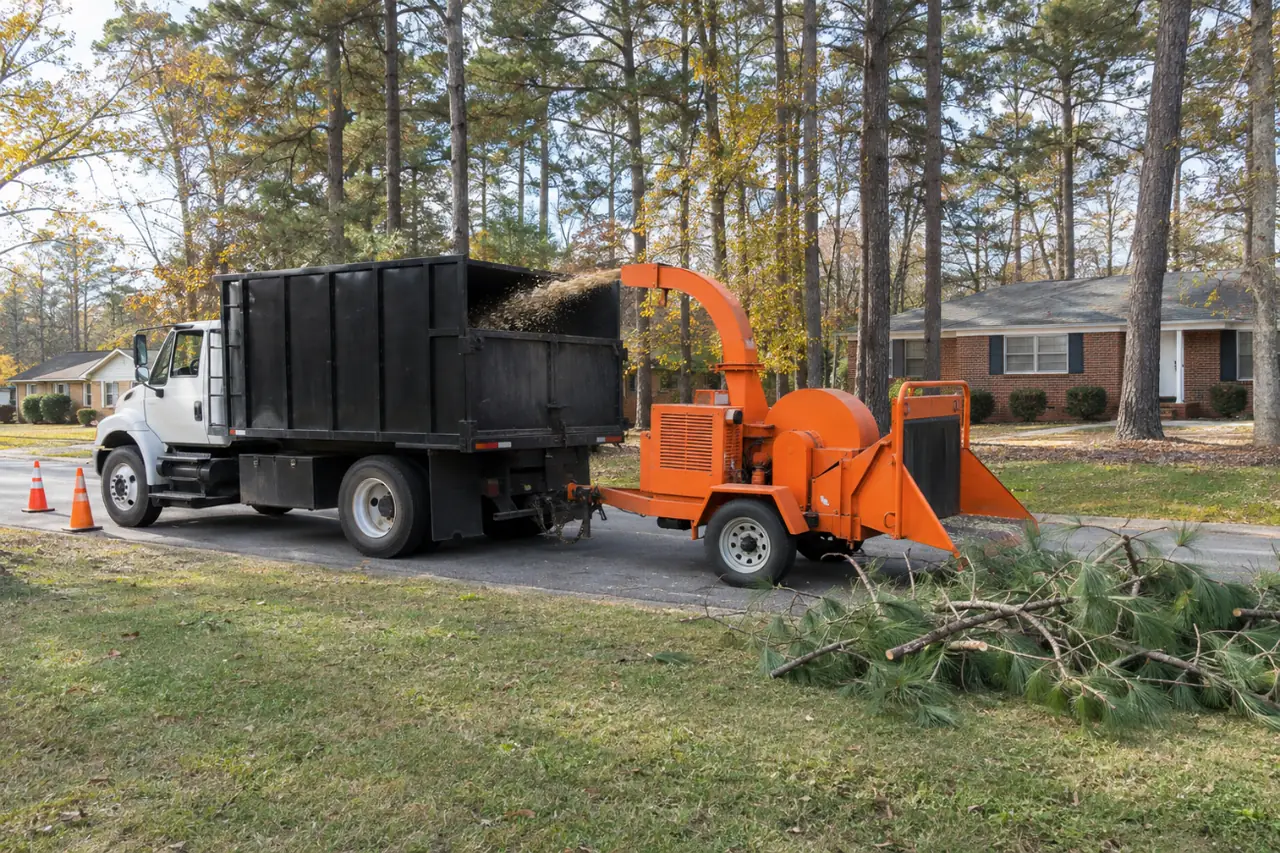
If you trim a few limbs yourself, the town picks up limbs cut to 6 feet or shorter and no more than 4 inches thick, stacked neatly behind the curb, no more than 4 feet high and 6 feet wide (Smithfield yard waste rules, checked Nov 21, 2026). Clayton's limits are different; see the Clayton page.
What to tell the contractor before the visit
- Where the tree stands and what it could land on: roof, carport, shed, fence, a neighbor's yard.
- Whether a power line runs through or near it, and whose: the Town of Smithfield, Duke Energy Progress or South River EMC. The power line page explains why it matters.
- How a truck would reach it: gate width, a soft spot, a septic tank or drain field to stay off.
- Whether it's near the river, a creek or a pond, because of the buffer rule.
- Whether you want the stump ground. Grinding is a separate step with its own 811 rule.
Price ranges for every size of tree are on the tree removal cost page. For a tree that's already down or hung up after a storm, go to storm tree removal.