
Short answer
Needles fading from green to yellow to red on a loblolly pine in Smithfield, NC are often a sign of pine bark beetles, and once that color change shows, the tree usually can't be saved. NC State Extension's guide to pine engravers says that by the time the beetles are discovered in a tree, "it is highly likely that the tree is doomed," so a red-topped pine within reach of a house, a driveway or a neighbor's roof is a removal job.
To have a fading pine looked at, call (984) 230-9281. One independent contractor who works in Smithfield and Johnston County comes out, checks it and prices the removal.
Which beetles kill pines around Smithfield?
NC State Extension names three pine bark beetles as the most common in North Carolina (NC State Extension, Pine Bark Beetles, Aug 4, 2022, checked Nov 21, 2026):
| Beetle | What the attack looks like | How serious |
|---|---|---|
| Southern pine beetle | Small pitch tubes tucked in the bark crevices; S-shaped tunnels under the bark; the whole crown changes color | The most serious. Outbreaks kill pines in groups and come back in cycles. |
| Ips engraver beetles (three species) | Pitch tubes often on the bark plates; tunnels shaped like an I, X, Y or H; sometimes only the top or some branches turn | Usually scattered trees, and attacks tend to ease when the stress, such as drought, ends. |
| Black turpentine beetle | Large pitch tubes on the lowest 15 feet of the trunk; wide, winding tunnels packed with frass | Goes after freshly wounded trees. Light attacks can be survived; heavy ones can spread to nearby healthy pines. |
All three leave the same thing in a yard: a pine whose needles turn light green, then yellow, then red. Extension calls these "red-topped" trees and says they are often the first-noticed sign of a bark beetle infestation. It also notes that a stressed pine may not have enough sap to push out pitch tubes, so the absence of tubes doesn't mean the tree is clean.
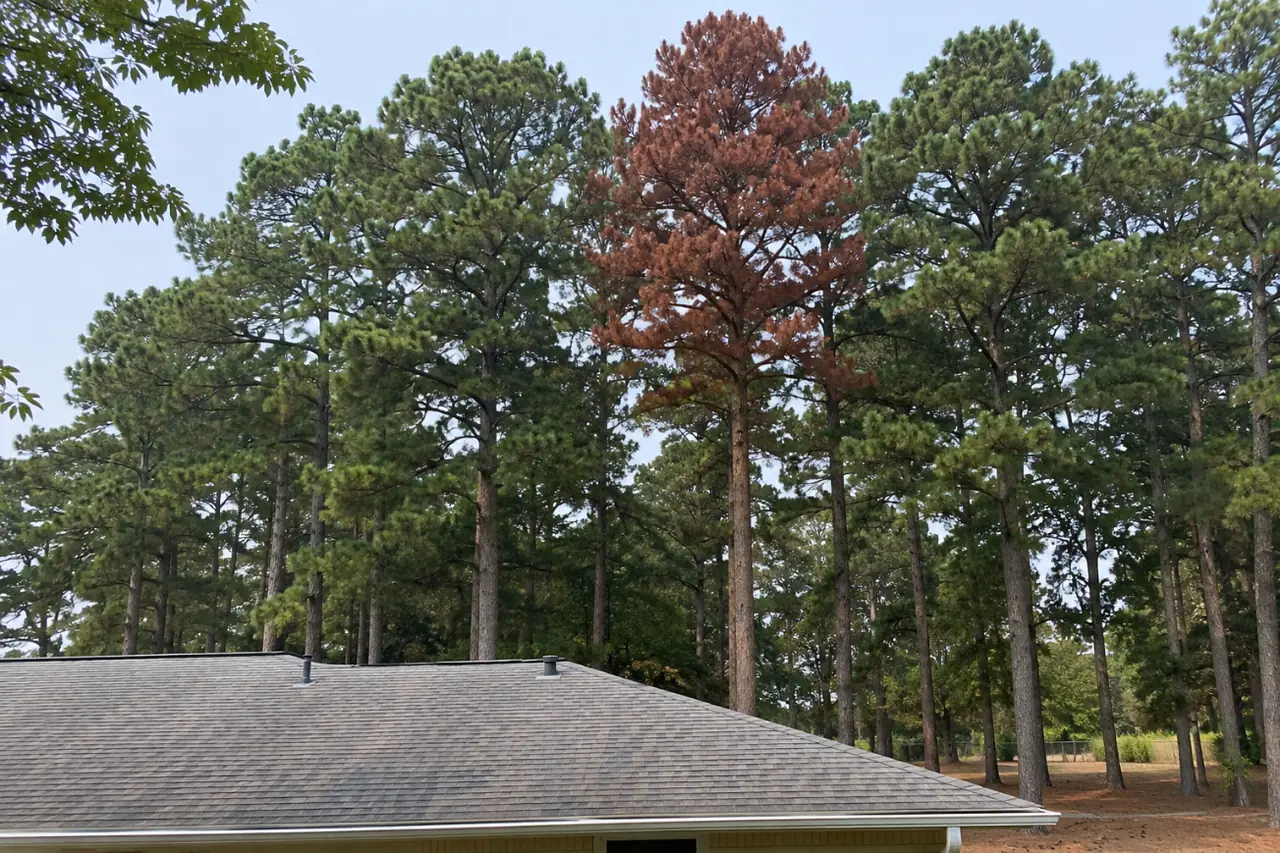
Why did this pine get hit and not the others?
Bark beetles go after pines that are already under strain. Extension lists drought, crowded stands, storm or fire damage and lightning strikes as the stresses that set pines up for engraver attacks, and says black turpentine beetles favor trees wounded by equipment, storms or fire. Its southern pine beetle page adds advice that reads like a list of what goes wrong in a yard: don't injure the bark, avoid heavy grading or packing the soil over the roots, and water pines during extremely dry weather, but don't fertilize them (NC State Extension, Southern Pine Beetle, revised Oct 14, 2019, checked Nov 21, 2026).
Around Smithfield, several of those stresses come together:
- Storms. Hurricanes, tornadoes and thunderstorms crack tops and snap limbs. The county's storm record is on the storm tree removal page.
- Floods. The University of Georgia Extension paper on flood damage, posted by the N.C. Forest Service, rates loblolly pine only moderately tolerant of flooding (checked Nov 21, 2026). Pines on low ground near the Neuse take that stress on top of everything else; see Neuse flooding and trees.
- Building and grading. New houses, additions, driveways and septic lines cut roots and pack the soil around pines that were left standing.
- Lightning. Extension names lightning strikes among the injuries that open a pine to engravers, so a struck pine near the house deserves a close look over the following months.
How fast does it happen?
Quickly in warm weather. Extension's engraver guide says that in hot weather an Ips generation can develop in as little as three weeks, and that the first sign of attack is often yellowing or reddening needles in the crown, sometimes starting at the leader and topmost branches (NC State Extension, Pine Engraver Beetles, revised May 15, 2024, checked Nov 21, 2026). The southern pine beetle runs three to five generations a year, becomes active in spring around the time redbuds and dogwoods bloom, and the beetles leaving one tree can move to stressed pines nearby, which is why pine deaths come in groups.
How much damage have these beetles done in North Carolina?
A lot. The N.C. Forest Service says that from 1998 to 2002 the southern pine beetle "destroyed $59.5 million worth of timber in North Carolina," and that the insect "periodically increases to epidemic proportions" (N.C. Forest Service, Southern Pine Beetle Prevention Program, checked Nov 21, 2026). In 2002 alone, the state's forest health report counted 4,028 southern pine beetle spots in 63 counties, a 47 percent jump over 2001, with 27 counties in epidemic status (North Carolina Forest Health Highlights 2002, USDA Forest Service, checked Nov 21, 2026).
Can a fading pine be saved?
Usually not once the crown has turned. Extension's southern pine beetle guide says spraying after a tree is infested has little practical effect. Protective pyrethroid sprays on healthy trees are expensive, the guide says, and may be worth considering only for valuable specimen trees. The engraver guide adds that high crowns are hard to treat with a homeowner's equipment, and that these products are very toxic to fish, so they shouldn't be used around ponds and streams. The one bright spot is the black turpentine beetle: Extension says pines with light attacks may survive.
A dead pine still standing beside a house is a hazard of its own. NC State Extension's plant notes say loblolly pine "is susceptible to wind damage" even when healthy (loblolly pine, checked Nov 21, 2026).
What should you do with an infested pine?
- Look at the neighbors. Check the pines around the red one for fresh pitch tubes on the trunk or a yellow tinge in the crown.
- Take the infested tree down promptly. For southern pine beetle, Extension's advice is to cut infested trees right away and remove or debark them immediately. For engravers, it's to cut the infested trees, debark them and destroy the slash.
- Get the wood off the property. Ask for logs and brush to be hauled or chipped rather than stacked beside the healthy pines. The Town of Smithfield won't collect debris left by a tree contractor (town yard waste rules, checked Nov 21, 2026), so hauling belongs in the price.
- Look after the pines that are left. Water them in a drought, keep equipment and fill dirt off their roots, and avoid wounding the bark.
A dead pine close to a house is often taken down in pieces from the top, so nothing drops uncontrolled onto the roof; the methods are on the tree removal page. Prices by height are on the cost page. A tree on a single-family lot in Smithfield doesn't need a town permit, but the state's stream buffer can still apply; see the permit page.