
Short answer
When a storm drops a tree in Smithfield or anywhere in Johnston County, the order is: get everyone clear, call the electric company about anything touching a wire, photograph the damage, call your insurance company, and then have a tree contractor take the tree off the house, car or drive. The county's record shows why that order matters: Hurricanes Fran, Floyd and Matthew and the April 2011 tornado all brought trees down across this part of North Carolina.
For a tree on the house or across the driveway, call (984) 230-9281. One independent contractor who works in Smithfield and Johnston County takes storm calls.
What does Johnston County's storm record show?
- Hurricane Fran, September 5–6, 1996
- The National Weather Service office in Raleigh reports that 1.7 million customers in North Carolina lost electricity, that damage to homes and businesses in the state ran to about $2.3 billion, and that forestry and timber losses "probably exceeded $1 billion" (NWS Raleigh, Hurricane Fran, checked Nov 21, 2026). The Neuse at Smithfield crested at 27.4 feet on September 8, 1996, still the second-highest crest on the Weather Service list (NWS gauge SMFN7, checked Nov 21, 2026).
- Hurricane Floyd, September 1999
- The U.S. Geological Survey measured a peak of 26.72 feet on the Neuse at Smithfield on September 18, 1999, with a flow above 17,800 cubic feet per second, a flood it rated as rarer than once in 50 years. Upstream near Clayton, the river peaked at 20.67 feet the day before, above Fran's 1996 peak of 20.12 feet there (USGS Water-Resources Investigations Report 00-4093, checked Nov 21, 2026), though the Weather Service's list for that gauge still has three older crests higher, led by 22.12 feet in 1945 (NWS gauge CLYN7, checked Nov 21, 2026).
- The ice storm of December 4–5, 2002
- The N.C. Utilities Commission found that most outages were caused by tree trunks or limbs falling onto distribution lines. At the peak, Progress Energy, the company that is now Duke Energy Progress, had 460,400 customers without power, and Duke had 1,042,034 (NCUC report, Sept 5, 2003, checked Nov 21, 2026).
- The tornado of April 16, 2011
- In its summary of that day's outbreak, NWS Raleigh describes what it calls the Fayetteville-Smithfield Tornado: on the ground for nearly 59 miles, it crossed I-95 a second time as it approached Smithfield and dissipated after going through the town. The summary lists more than 100 injuries and $116,100,000 in damage for that tornado (NWS Raleigh, April 16, 2011, checked Nov 21, 2026).
- Hurricane Matthew, October 2016
- NWS Raleigh's summary says 12 to 15 inches of rain fell in an arc running northeast from Lumberton through Fayetteville toward Goldsboro. It attributes 29 deaths in North Carolina to Matthew, all of them in inland counties, and states that "Four fatalities were attributed to Hurricane Matthew in Cumberland, Johnston, and Lenoir Counties." More than 1.6 million customers lost power statewide, most of the outages tied to uprooted hardwood trees, and the Neuse at Smithfield reached a record 29.09 feet (NWS Raleigh, Hurricane Matthew, checked Nov 21, 2026).
- The August 2018 storm in south Smithfield
- Not every damaging storm has a name. On the night of August 8–9, 2018, sudden winds brought down trees, limbs and leaves in south Smithfield near the Country Club of Johnston County. Emergency officials said at least 12 homes had significant damage, with British Court and Country Club Road hit hardest, and Duke Energy crews restored lines the storm knocked down (WRAL, Aug 9, 2018, checked Nov 21, 2026).
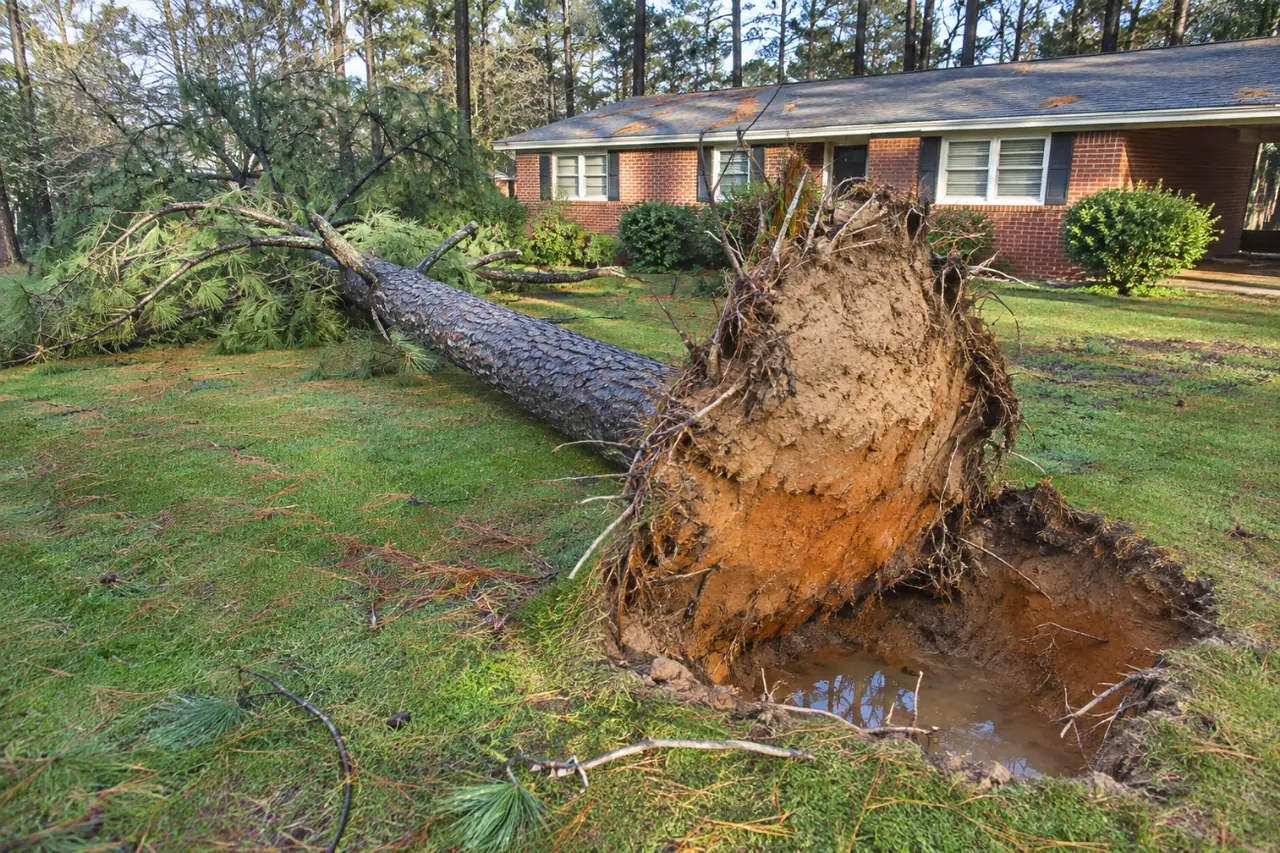
What should you do first when a tree falls?
- Get people and pets away from the tree, the damaged part of the house and any wire. If anyone is hurt or something is burning, call 911.
- Treat every downed wire as live. Call the line's owner. Inside the Town of Smithfield's electric system the Operations Center is 919-934-2798 (Town of Smithfield utilities); Clayton Public Power takes outage calls at 919-553-1530 (Town of Clayton Electric); Duke Energy Progress and South River EMC customers call their own company (all checked Nov 21, 2026).
- Photograph before anything moves. The N.C. Department of Insurance says to photograph and list the damage before doing any temporary repairs (NCDOI claims and adjuster information, checked Nov 21, 2026).
- Stop more damage. A tarp over a hole in the roof is a temporary repair; NCDOI says to keep the receipts for materials.
- Call your insurance company or agent as soon as possible to arrange an adjuster's visit, and hold off on permanent repairs until the insurer has inspected.
- Then call for the tree. Taking a tree off a roof is rigging work, done from the top down, so nothing slides further into the house.
Don't walk under a tree that's hung in another tree, and don't cut a trunk that's bent or pinned. Wood under load can spring sideways when it's cut, and an uprooted tree's root plate can tip back into its hole once the trunk is cut away from it.
What will homeowners insurance pay for?
The N.C. Department of Insurance answers the common questions this way (NCDOI homeowners insurance FAQ, checked Nov 21, 2026):
- A homeowners policy covers tree removal up to $500 for any one loss, but only when the tree damaged a structure or blocked the driveway.
- Generally, if a tree falls on your home, even a neighbor's tree, your own homeowners policy covers the damage.
- Because removal coverage depends on damage to a structure or a blocked drive, a tree that falls in the yard without doing either sits outside it.
- Damage to your car from a falling tree goes under the comprehensive part of an auto policy.
- Homeowners policies do not cover flood or rising water. Flood coverage is bought separately through the National Flood Insurance Program.
That $500 rarely covers a big pine taken off a roof. Your policy, not this page, has the final word, so read it or ask your agent.
Who hauls away the storm wood?
Not the town, if a contractor cut it. The Town of Smithfield's yard waste rules say it will not collect debris left by a tree service contractor (Smithfield yard waste, checked Nov 21, 2026). Duke Energy says it does not clean up tree debris after severe weather and leaves disposal to the property owner (Duke Energy trees FAQ, checked Nov 21, 2026). After a widespread storm, towns sometimes announce special debris pickups; watch for the notice from your town.
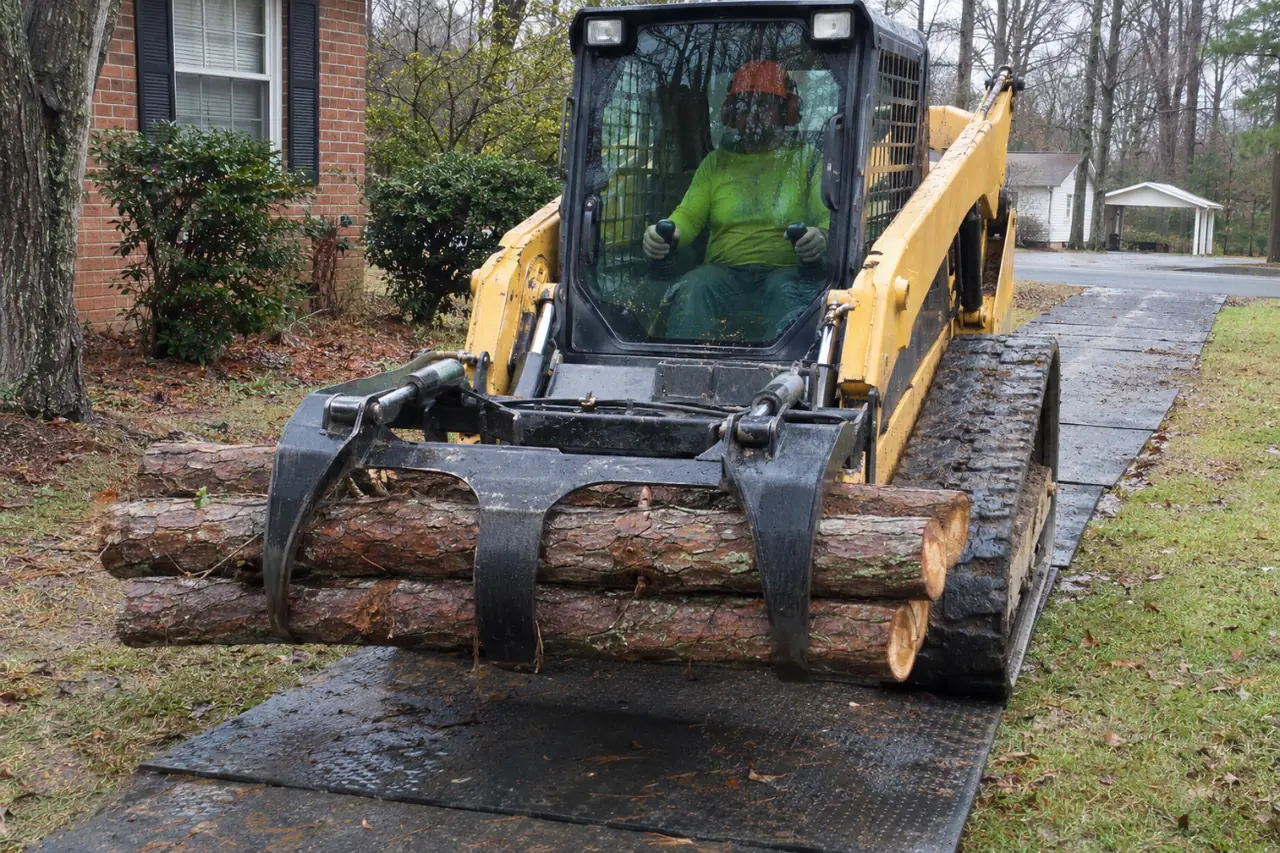
What about crews that show up after a storm?
North Carolina's Department of Justice advises getting a written contract that lists the work, its costs and a completion date, not paying for work up front, avoiding cash, and being wary of people who go door to door offering services. It also notes that state law limits what businesses can charge once the Governor declares a disaster or emergency, and takes complaints at 1-877-5-NO-SCAM (NC DOJ, disaster repair, checked Nov 21, 2026). The hiring tree work page has more on contracts and deposits.
If the storm left a tree leaning but standing, read Neuse flooding and trees for the warning signs in soaked ground, or see tree removal for how a standing tree is taken down.