
Short answer
When the Neuse floods in Smithfield, NC, the trees on low ground sit in soaked soil, and soaked soil plus wind is how big hardwoods come out of the ground roots and all. The National Weather Service's Raleigh office linked most of Hurricane Matthew's 1.6 million North Carolina power outages to uprooted hardwood trees, and Matthew put the river at Smithfield higher than any crest on record.
If a tree on your lot is leaning or heaving after high water, call (984) 230-9281. One independent contractor working along the Neuse in Johnston County will come and look.
How high has the Neuse come at Smithfield?
These are the eight highest crests on the Weather Service's list for the Neuse River at Smithfield. Flooding begins at 15 feet, moderate flooding at 18 and major flooding at 20.
| Date of crest | Height on the gauge | Storm |
|---|---|---|
| Oct 10, 2016 | 29.09 feet | Hurricane Matthew |
| Sept 8, 1996 | 27.4 feet | Hurricane Fran |
| Aug 1, 1908 | 27.1 feet | |
| July 24, 1919 | 26.8 feet | |
| Sept 18, 1999 | 26.72 feet | Hurricane Floyd |
| Oct 3, 1929 | 26.4 feet | |
| Sept 20, 1945 | 25.9 feet | |
| April 27, 2017 | 25.36 feet |
Source: National Weather Service, Neuse River at Smithfield (SMFN7), historic crests and flood categories, checked Nov 21, 2026. Storm names from NWS Raleigh's Matthew summary and USGS report 00-4093 on Floyd.
Three of the top five came in a 20-year stretch. The U.S. Geological Survey rated Floyd's flow at Smithfield as rarer than a once-in-50-years flood, and Matthew went higher still.
Which parts of Smithfield flood first?
The Weather Service's impact notes for the Smithfield gauge describe what goes under at each height (checked Nov 21, 2026):
- 14 feet: the river begins to overflow its left bank.
- 15 feet: flooding begins along the Neuse Riverwalk.
- 18 feet: the town park and the Riverwalk at the US 70 bridge flood.
- 20 feet: major flooding, which cuts off the water treatment plant's access to its reservoir.
- 23 feet: Hospital Road and Buffalo Road flood.
- 28.5 feet: the water treatment plant floods, with Jaycee Park and North Front Street.
- 30 feet: houses on the river side of Front Street flood.
Matthew's 29.09 feet sits just under that last line. Yards along the creeks that feed the Neuse can flood from heavy local rain even when the river itself stays lower.
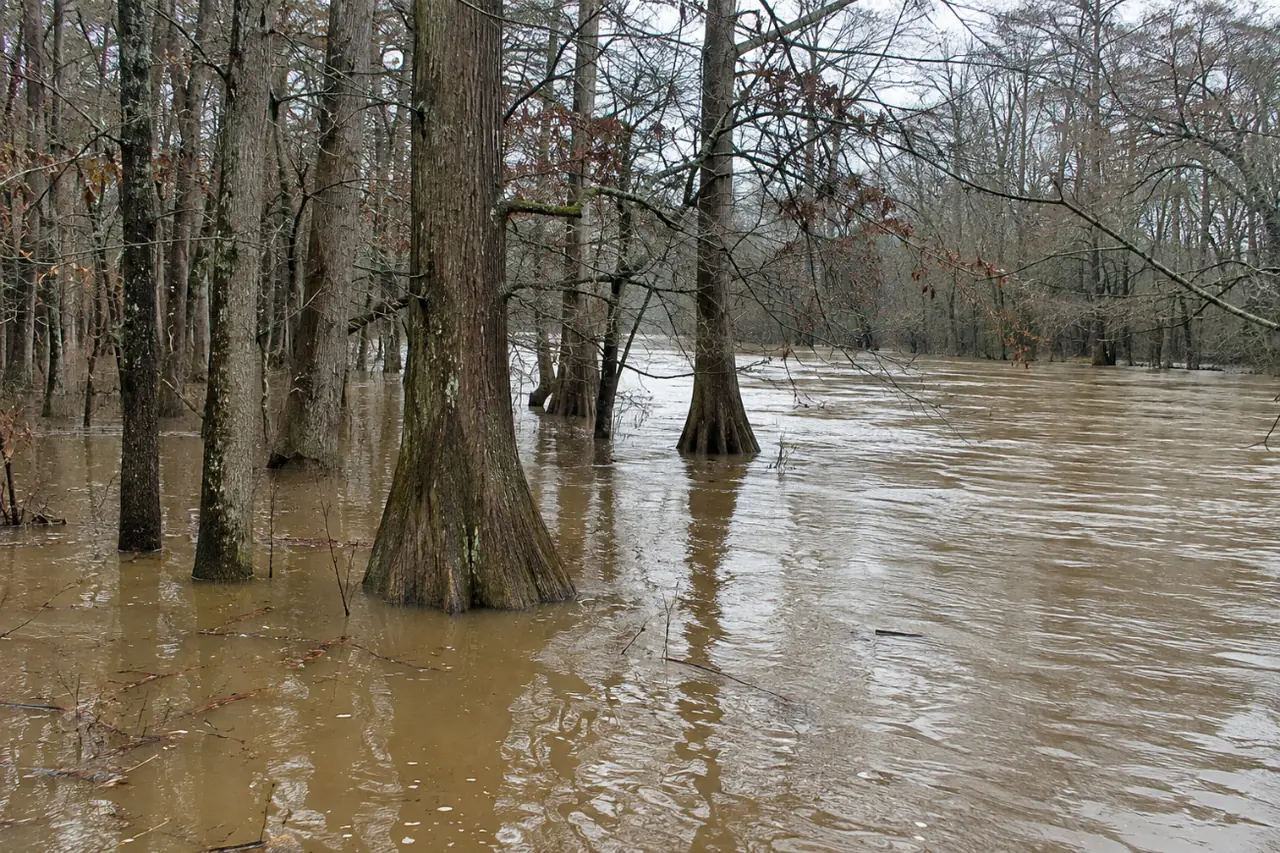
What does high water do to yard trees?
A tree holds itself up with a plate of roots gripping the soil. When that soil is full of water it grips less, and a tree with a full crown of leaves can be pushed over by wind that it would ride out in dry weather. That's the pattern NWS Raleigh described after Matthew: the outages were "associated with uprooted hardwood trees" (NWS Raleigh, checked Nov 21, 2026).
The University of Georgia Extension paper Flood Damage to Trees, which the N.C. Forest Service posts for landowners, explains the rest of the damage (Kim D. Coder, FOR94-61, July 1994; N.C. Forest Service copy, checked Nov 21, 2026):
- Roots run out of air. Water fills the soil pores that normally hold air, and roots stop growing within about a week. Fine roots suffer most.
- Light winds can topple them. Saturated soil loosens the roots' grip, so trees may go over in winds they'd normally ride out, and in moving water one falling tree can knock down the next.
- Silt over the roots. Floods can leave sediment from almost nothing to six feet or more over the root zone, and trees have to grow new roots up into it.
- The damage lingers. The paper says flood effects can last two to three years and pest problems up to five, and that root loss leaves a tree more open to drought and windthrow the following season.
Species differ, too. The same paper's table ranks bald cypress and sweetgum as tolerant of flooding, loblolly pine as moderately tolerant, and tulip poplar as intolerant.
What should you check after the water drops?
Walk the yard once it's safe and look at each big tree, especially any that could reach the house, a driveway or a neighbor's roof:
- A new lean. Check it against an older photo. A tree that has started to lean since the storm is moving at the roots.
- The soil at the base. Cracks, a raised mound or a gap on one side of the trunk mean the root plate has shifted.
- Exposed or snapped roots, especially on a bank.
- Trunk damage from debris, and mushrooms or soft wood at the base later on.
- The crown next season. Thin leaves, early color or dead branches appearing in a tree that was full before.
A tree showing the first two signs near a house is the one to have looked at soon. The others can be watched and checked again.
Stay out from under a leaning tree in saturated ground. It can finish falling with no wind at all.
Does insurance cover flood damage?
Not a homeowners policy. The N.C. Department of Insurance says "Homeowners policies do not cover flood or rising water damage," and that flood insurance can be bought through the National Flood Insurance Program (NCDOI FAQ, checked Nov 21, 2026). Tree removal coverage under a homeowners policy is limited to $500 per loss and only when the tree damaged a structure or blocked the driveway. The storm page has the claim steps.
Can you cut trees along the river or a creek?
Carefully. The state's Neuse buffer rule protects a 50-foot strip along mapped streams, ponds and the river, with the first 30 feet (Zone 1) the most protected. Maintained lawns that are already there are an existing use, and Johnston County's summary lists removing trees in danger of damaging structures or human life among the activities the rule addresses. Other cutting in the buffer may need written authorization first. The details and phone numbers are on the Smithfield tree permit page.
Upstream in Clayton the river behaves differently: there, the 1945 crest is still the record. See the Clayton page. For a tree that has to come down, see tree removal.