
Short answer
For tree service in Clayton, NC, three local rules decide most jobs: the town's Tree Clearing Certificate under UDO Section 2.3.30 (aimed at land with no approved development plan, with single lots in approved single-family subdivisions exempt), a ban on removing or topping trees on public property and designated rights-of-way except by the town or a utility when it's needed to protect public health, safety or welfare, and limb pickup limits that differ from Smithfield's. Most homes in town limits get power from Clayton Public Power, not Duke, which changes who to call about limbs on a line.
Call (984) 230-9281 and one independent contractor who works in Clayton and the rest of Johnston County will look at the tree and price the job.
Why Clayton gets its own page
Clayton runs on its own rule book, and it's growing fast. The American Public Power Association's May 2026 profile of the town's electric utility puts Clayton at about 31,732 residents and reports that its electric system director believes the population could double again within 10 years (APPA, May 4, 2026, checked Nov 21, 2026). Its development ordinance, its power company, its limb pickup and even the way the Neuse floods there are different from Smithfield's, farther down the river.
Does Clayton require a permit to cut trees?
For a house in an approved single-family subdivision, generally not. Clayton's Unified Development Ordinance was adopted November 20, 2023, took effect January 2, 2024, and was last amended June 15, 2026 (Town of Clayton UDO page, checked Nov 21, 2026). Section 2.3.30 sets up the Tree Clearing Certificate. Its stated purpose is to "establish some basic requirements for preserving existing vegetation around the perimeter of lots, or tracts." Under subsection B, as amended July 21, 2025, a certificate is required for land-disturbing activities on a site, lot or part of a lot "that is not subject to an approved Major Subdivision, Site Plan, Conditional Rezoning, Zoning Compliance Permit, Erosion Control Permit, or similar development approval."
Subsection C lists what doesn't need one:
- Removing trees on "a single lot located within an approved single-family residential subdivision" zoned for single-family use, as long as the trees aren't required landscaping.
- Removing trees on land already under an approved major subdivision, site plan, conditional rezoning, zoning compliance permit or erosion control permit, following that approval's tree protection terms.
- Forestry on land taxed at present-use value, or under a plan from a North Carolina registered forester.
- Work by public or private agencies in street rights-of-way, utility easements and town property.
- Town-initiated or town-approved removal of unsafe, nuisance or noxious vegetation, or vegetation infected with an injurious fungus, insect or other pest.
The certificate's tree save areas run 50 feet deep along public roads and along developed neighbors, and 25 feet along undeveloped land. If 80 percent or more of the trees the section would have protected are removed without a certificate, the town won't accept rezoning, special use, major subdivision or site plan applications for that land for five years; the Town Council can shorten or lift that by a three-quarters vote.
Source: Town of Clayton UDO, Sec. 2.3.30 (amended through June 15, 2026), checked Nov 21, 2026.
An older house on its own lot, outside a platted subdivision, isn't named in the exemption list. If that's your situation, or you plan to clear part of a wooded tract, call Clayton's Planning Department before cutting.
Where Clayton's rule came from
Clayton's power to regulate clearing before development comes from a local act of the General Assembly. Session Law 2006-115 (Senate Bill 1928, ratified July 13, 2006) let Clayton and Reidsville adopt ordinances limiting clear-cutting in buffer zones before development: up to 50 feet along public roads and next to developed land, and 25 feet next to undeveloped land. The act also says "tracts of two acres or less are exempt from the requirements of the ordinances" (S.L. 2006-115, checked Nov 21, 2026). Section 2.3.30's own exemption list doesn't repeat the two-acre line, so ask the town how it applies to your tract.
Can you remove or top a street tree in Clayton?
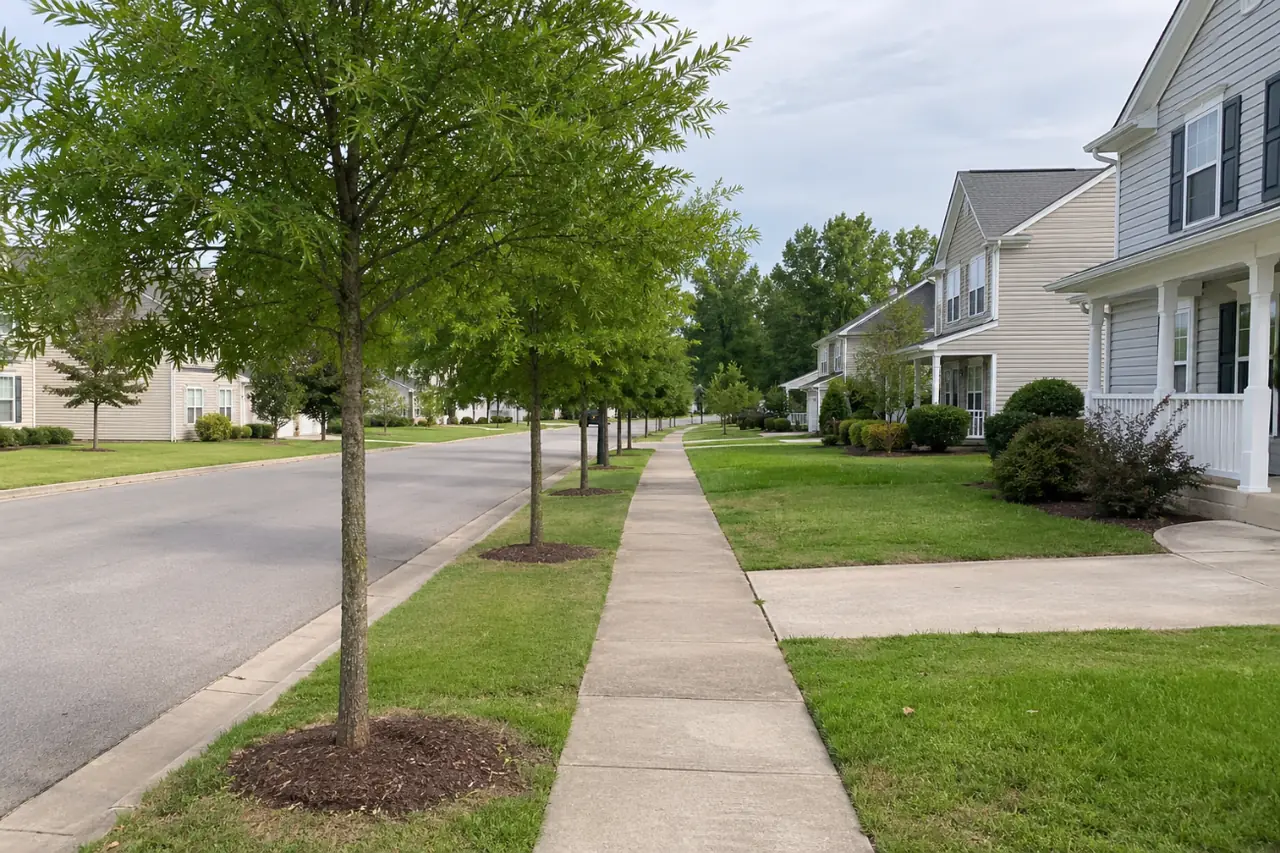
No. UDO Section 6.6.19 G says: "The removal or topping of trees shall be prohibited on public property and designated rights-of-way unless such activity is conducted by the Town or a public utility provider, and is necessary to protect public health, safety, or welfare." Ask the town before pruning a tree that may stand in the right-of-way. The Planning Director can exempt trees "severely damaged by storms or other causes."
Newer subdivisions add a second wrinkle. Trees planted to meet the UDO's landscaping requirements are protected too. Under Section 6.6.19, damaging or removing required landscaping is a violation, any required tree at least 8 inches in caliper that is damaged or removed must be replaced under a revegetation plan the Planning Director approves, and pruning beyond TCIA standards counts as a violation as well (Clayton UDO, Sec. 6.6.19, checked Nov 21, 2026). If a tree in your yard was planted by the builder as part of a buffer or streetscape, find out before it goes.
Who trims near power lines in Clayton?
It depends on the address. Clayton's electric department, Clayton Public Power, says it serves "the majority of residential and business customers within the Town Limits," and points Duke Energy Progress customers, giving the Riverwood subdivision as an example, to Duke. The town describes an "aggressive tree-trimming program" whose crews "only perform work needed to maintain reliable electric service." Outages and other electric service calls go to 919-553-1530 (Town of Clayton Electric, checked Nov 21, 2026).
The utility goes back a long way: APPA's profile says the town formed its electric department in 1913 and now has 9,500 electric customers (checked Nov 21, 2026). In July 2018 the town had line-clearance crews trimming in wooded utility easements along Birkdale Drive, Hawkesburg Drive, Torrey Pines Drive and Vinson Road, the JoCo Report noted, because limbs over lines are a major cause of outages in wind, rain and ice (JoCo Report, July 6, 2018, checked Nov 21, 2026).
For the wire from the pole to your house, the line's owner sets the procedure. Duke's version is on the power line page; Clayton Public Power customers call the town first.
What will Clayton pick up at the curb?
Clayton takes thicker wood than Smithfield does, as long as it's cut short. Under Section 96.04 of the town code (last amended December 1, 2014):
- Limbs up to 4 inches thick go out in lengths of 6 feet or less.
- Limbs over 4 inches and under 10 inches must be cut into lengths of 2 feet or less.
- Limbs greater than 10 inches in diameter will not be collected.
- Piles can be no more than 6 feet deep, 3 feet high and 6 feet wide, stacked behind the curb with the sawed ends toward the street.
- Tree cuttings from a tree care professional hired by a resident aren't collected unless they meet those limits, and trees, stumps and limbs from land clearing are the owner's or contractor's to remove.
Source: Clayton Code of Ordinances, Sec. 96.04, checked Nov 21, 2026. Smithfield's rules are 6 feet and 4 inches, with contractor debris not collected at all.
How does the Neuse flood at Clayton?
Differently from Smithfield. On the National Weather Service gauge for the Neuse River near Clayton, minor flooding starts at 9 feet and major flooding at 16. The highest crest on its list is still 22.12 feet from September 19, 1945. Floyd reached 20.67 feet in 1999, Matthew 20.48 feet in 2016 and Fran 20.12 feet in 1996. The Weather Service's impact notes say water reaches the edge of the Neuse River Greenway trail at 9 feet, the greenway closes at 13 feet, and at 18 feet Castleberry Road off NC 42 floods and water approaches the entrance to East Clayton Elementary School (NWS gauge CLYN7, checked Nov 21, 2026).
At Smithfield, Matthew set the all-time record; at Clayton, it ranks fifth. Trees on low ground along the greenway and the creeks feeding the river still sit in saturated soil after big storms. What that does to roots is on the Neuse flooding page.
What to tell the contractor about a Clayton job
- Your subdivision's name, or that the house is on its own older lot.
- Whether the tree stands in the strip between the sidewalk and the street, or in a buffer the builder planted.
- Who sends your power bill: the Town of Clayton or Duke Energy Progress.
- Whether you want the wood cut to Clayton's pickup lengths or hauled off.
- Whether a creek, pond or the river is within about 50 feet, because the state's Neuse buffer rule applies in Clayton too.
Prices for Clayton jobs follow the same published ranges as the rest of the county; see the tree removal cost page. For storm damage, start with storm tree removal.